
Standardised assessment
Age-appropriate language and articulation screens (REELS, OWLS-II, GFTA-3-informed). Written assessment, paediatrician sign-off.
1-on-1 online speech and language therapy for late talkers, articulation difficulties, fluency, and social communication. Plans authored by our team of developmental paediatricians, sessions delivered by senior speech-language pathologists.
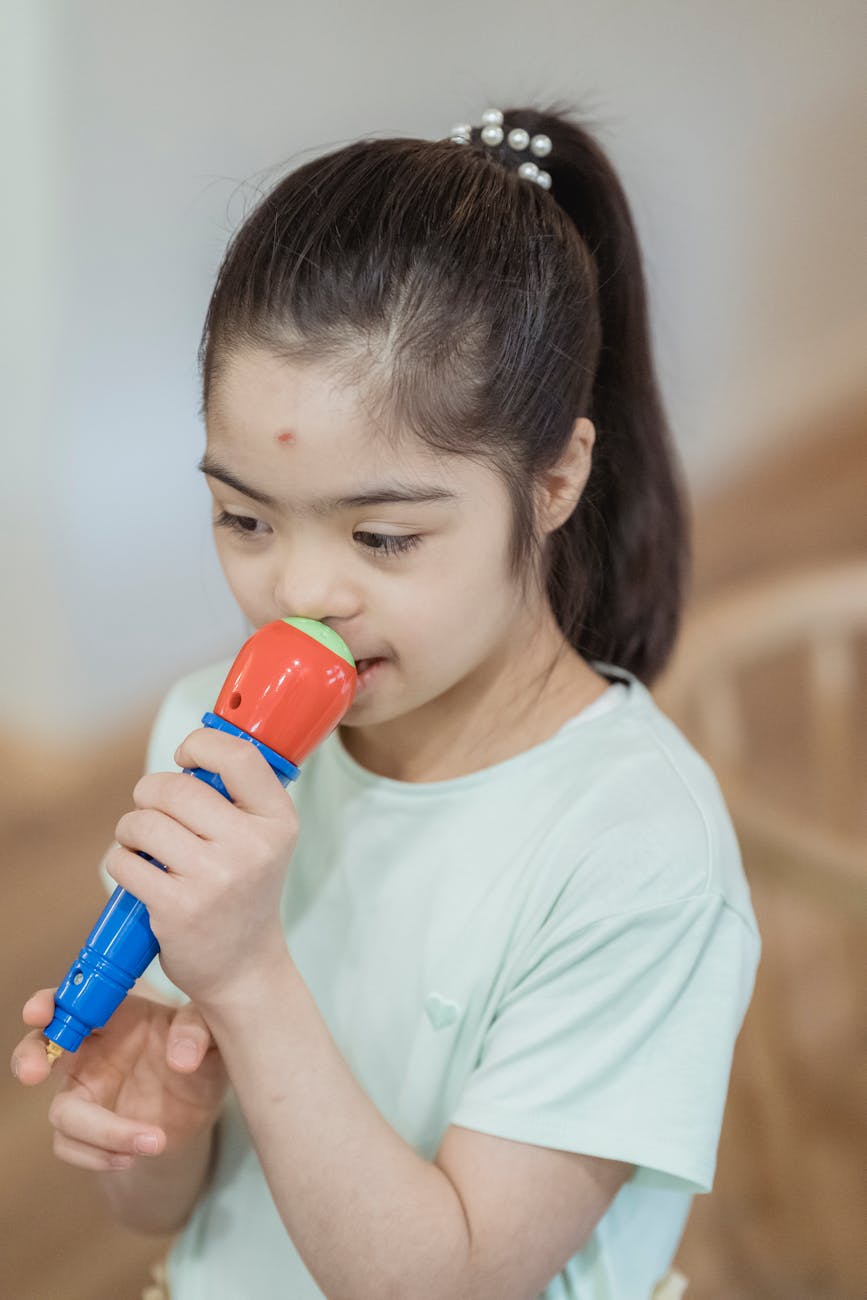
A 30-minute consultation with a developmental paediatrician or senior therapist. We listen, observe, and give you an honest read on whether speech & language therapy is the right starting point.
Speech and language therapy helps children learn to understand language and use it — first words, clear sounds, fluent sentences, and the back-and-forth of conversation. A speech-language pathologist (SLP) assesses where a child’s communication is stuck and works through structured, play-based sessions to move it. At NeuroNurture, therapy is delivered online, 1-on-1, by senior SLPs, with every plan authored and reviewed by a developmental paediatrician.
The system being treated is bigger than “speech.” It spans receptive language (what the child understands), expressive language (what the child produces), articulation (how clearly sounds come out), fluency (stammering), and pragmatics (how language is used socially). The assessment tells us where the gap is most pressing; the plan says what we work on first, and what change to expect by week four, twelve, and twenty-four.
Most children who come to us fall into one of six groups: late talkers between 18 months and 3 years; children aged 3–5 whose speech is hard for people outside the family to understand; children who stammer; autistic children and children with ADHD whose plans need a communication component; children growing up in multilingual households where a delay is suspected; and school-age children whose language gaps have started to show up in classwork and friendships.
The most common question we hear — my child is two and not talking, should we wait? — has a clear clinical answer. Both the Indian Academy of Pediatrics and the American Academy of Pediatrics recommend evaluating rather than waiting past the second birthday. Roughly 70–80% of late talkers catch up on their own; the 20–30% who don’t lose the most valuable intervention window if everyone waits to find out which group they’re in. An assessment settles the question — ours is free.
As rough markers: no babbling by 12 months, no first words by 16–18 months, fewer than 50 words or no two-word combinations by 24 months, speech mostly unintelligible to strangers at 3 years, or any loss of previously acquired words at any age. Any one of these justifies an evaluation — not panic, an evaluation.
Assessment first, in writing. We use age-appropriate standardised screens (REELS, OWLS-II, GFTA-3-informed) alongside parent interview and direct observation. The output is a written report and plan, signed off by our developmental paediatrician, before the first therapy session.
Under-6s get play, structured invisibly. Sessions look like guided play because that is how young children learn language. The therapist follows the child’s lead and slips communication practice into whatever the child is already doing (clinicians call this milieu teaching). A child who wants the yellow block is a child with a reason to say “yellow.”
Articulation work is systematic. Where specific sounds are the target, we start with the sounds your child can nearly say, then practise them through word pairs that differ by a single sound — ‘bed’ versus ‘red’ — woven into the family’s daily routines rather than handed out as worksheet homework.
Parents leave every session with one thing. The final minutes of each session are a debrief: what we worked on, what improved, one specific thing to repeat at home this week. Language grows in the 167 hours between sessions; the debrief is how the plan reaches them.
Sessions run 30 minutes, one to three times a week depending on the plan. The first four weeks establish the baseline and usually produce the first shifts — more initiation, more attempts. Between weeks four and twelve, targeted goals start generalising from session into home routines. By weeks twelve to twenty-four, most goals are met or revised, and many children step down to weekly sessions. Progress is written down every week, and our paediatric team re-reviews the plan every four weeks.
Home is where language actually lives. When a child masters a target word in their own kitchen, with their own caregiver watching, the chance of that word appearing at Tuesday’s breakfast is far higher than when it’s mastered in a clinic and has to survive a forty-five-minute commute home. The published evidence comparing telehealth and in-person speech therapy shows equivalent outcomes when sessions are well-designed.
For Indian families the practical case is stronger still. Qualified paediatric SLPs are heavily concentrated in metro cities; families elsewhere face waitlists, long commutes, or no local option. Online delivery means a child in Kochi or Chandigarh works with the same senior SLP, on the same weekly schedule, as a child in Bengaluru. Multilingual households are normal for us — multilingualism does not cause delay, and we plan targets across the languages your child actually lives in.
Sessions are priced per 30-minute session, with monthly packages available. The first 30-minute consultation is free and carries no obligation. If the assessment tells us speech therapy alone isn’t the right answer — that OT, ABA, or evaluation for an underlying condition would help more — we say so. Our job is your child’s progress, not the loyalty of your sessions.
The American Academy of Pediatrics’ clinical guidance on developmental surveillance calls for structured screening and early referral rather than watchful waiting when language milestones are missed. ASHA’s practice guidance on late language emergence documents both the catch-up statistics and the predictors that separate transient delay from persistent disorder. Our assessment battery and milestone thresholds follow the Indian Academy of Pediatrics’ developmental screening reference. Full citations are listed below.
Age-appropriate language and articulation screens (REELS, OWLS-II, GFTA-3-informed). Written assessment, paediatrician sign-off.
For under-6s, sessions look like guided play. The therapist follows the child's lead and slips communication practice into whatever the child is already doing.
Where specific sounds are the focus: we find the sounds your child can nearly say, then practise words that differ by just one sound ('bed' vs 'red'). Built into the family's daily routine, not handed out as homework.
Three to five minutes at session end. What worked, what improved, one specific thing to repeat at home this week.
Per-session pricing varies with session length, modality, and senior-clinician supervision. We share the full quote with you before any commitment — and the first 30-minute consultation is always free.
Still deciding if speech & language therapy with NeuroNurture is right for your child? These are the questions parents most often bring to a first call.
Most families see early shifts in 4–6 weeks — a child initiating more, attempting target sounds, or repeating a word at home. Sustained, generalised gains take 3–6 months. We track it weekly in writing, so you don't have to rely on memory.
The Indian Academy of Pediatrics and the American Academy of Pediatrics both recommend evaluating, not waiting, past the second birthday. Roughly 70–80% of late talkers catch up — but the 20–30% who don't are best served by starting early. A free assessment tells you which group your child is in.
No. Multilingualism does not cause language delay; exposure to two or three languages from birth is developmentally enriching. The work, when delay is present, is prioritising targets across languages — not dropping a language.
For late talkers, articulation, social-communication, and language disorders, the evidence shows online and in-person produce equivalent outcomes when sessions are well-designed. Children often generalise faster online because home becomes the practice environment.
Yes. Speech therapy is one of the most evidence-supported interventions for autism, particularly in early childhood. We coordinate the plan with ABA, OT, and parental coaching where indicated.
Medically reviewed by Dr. Neha Kukreja, Chief Medical Officer & Developmental Paediatrician. Educational content; not a substitute for clinical consultation.
Doctor-supervised early intervention for children aged 0 to 3 years — the brain's most plastic developmental window. Family-first, play-based, online sessions with weekly written progress reports.
A multidisciplinary online autism programme for children — coordinating speech therapy, ABA, occupational therapy, and parental coaching under one paediatrician-authored plan.
Online parental coaching for parents of children with developmental, behavioural, or learning needs. Structured parent-management training, daily-routine design, and the operating-manual handoff.
30 minutes with a developmental paediatrician or senior therapist. We assess your child's needs and recommend the right programme. Free, no obligation.